“Stop it.
Stop it.
Stop it right now!” Matthieu stands up and turns to face him. For over an hour, a young man acting strangely has been circling us on the banks of the Han River. He’s singing—or at least we think he’s singing—with headphones that don’t even seem to be connected to his phone. He approaches one of us, then the other, walks away, comes back, and shouts words or songs at us that we don’t understand. At first, he doesn’t seem to pose any danger, so we simply choose to ignore him.
We’re waiting for the sunset near Banpo Bridge, famous for its fountains that cascade into the river. We’ve had our spot for almost an hour, and the light is finally starting to look beautiful when the young man returns. This time, his behavior changes. He starts hitting us on the top of the head. We clearly tell him to stop, then turn back to the scenery, hoping that will be enough. A few seconds later, he starts again.
This time, it’s several punches to the back.
Matthieu stands up immediately and turns around to confront him head-on.
“Stop it. Stop it. You stop it now!” Around us, several people start apologizing on his behalf. We don’t know what’s driving this young man to act this way, but the situation becomes aggressive enough that we decide to leave. After all, we’re in the land of *Squid Game* and a few excellent survival movies.
No need to test the limits of cultural immersion.
After waiting nearly an hour for the sunset, we give up our spot just as it finally begins. And at that moment, a question seriously starts to cross our minds: what on earth have we just walked into? It’s worth noting that we’ve been in Seoul for less than twenty-four hours. Our flight landed around midnight. Immigration, a bus from the airport, a short walk down a few streets, and around 2 a.m.
we discovered our home for the next six nights: an 11-square-meter room, probably the smallest we’ve ever slept in. A 140-centimeter bed for the two of us, our bags, and not really much room left for anything else. Yet we grew to love it pretty quickly. It’s clean, very conveniently located near the subway and the airport bus, and the price is a bargain by Seoul standards. Breakfast is basic but included: bread, eggs, butter, and jam in a self-service fridge, with water and coffee available. It’s also here that we encounter our first Korean mystery: the bath towels.
About 40 × 80 centimeters—roughly the size of a hand towel back home. Naturally, we’re looking for the big ones.
There aren’t any. With two of us in an 11-square-meter room, in a 140-centimeter bed, and an 80-centimeter towel to dry off after a shower, Korea is off to a pretty good start. The next morning, we want to do a little exercise without disturbing anyone. Just a few minutes away is the Dongdaemun Design Plaza, or DDP, a massive building with curved metal structures designed by Zaha Hadid. In the park, we discover a shaded area with self-service exercise equipment, including jump ropes and hula hoops. During our workout, some Americans of Korean descent come over to play with us. We chat about travel; they advise us to make the most of it while we’re young.
We explain that we’ve actually set out on a year-long trip, and their reaction makes us laugh. For a first encounter, it’s hard to imagine a friendlier one. After a shower and breakfast, we head back to the DDP—this time to go inside. We stumbled upon an exhibition by the Korean illustrator Keykney, and Sébastien—who clearly hadn’t adjusted his mind to Korean prices yet—bought two tickets for 44,000 won without thinking twice.
One small detail: much of the exhibition is in Korean. In the end, we love it. With plenty of humor, Keykney sketches family life, relationships, and all sorts of little scenes from everyday Korean life. We don’t understand every speech bubble, but the drawings are often enough to grasp the situations. For our first day in the country, discovering certain family norms, traditions, and the little absurdities of daily life through a comic book turned into an exhibition was an excellent introduction to Korean culture.
Then came our first encounter with the subway. And right away, Seoul made a big impression on us. It’s huge but surprisingly quiet. The stations are clean, the platforms orderly, the signage clear, and people speak very little. Above all, we discover that the subway seems to have been designed as much more than just a means of transportation. There are clean, free restrooms everywhere, along with shops, vending machines, and all sorts of small services. It’s an infrastructure designed not only to move millions of people but also to make their lives easier.
It’s a level of comfort we’re much less accustomed to in European or North American subways. You just have to figure out how to buy and then recharge your transit card, since our foreign credit cards don’t let us do everything directly. So we head out to get some cash.
That’s when two young women approach us. They’re smiling, ask us where we’re from, and then pretty quickly suggest we experience a traditional Korean ceremony. They show us photos, explain the ritual, and insist that we go with them. The place is supposedly about fifteen minutes away.
We decline. They insist. We decline again.
We eventually discover that this kind of approach—under the pretext of introducing people to a Korean ceremony or tradition—is frequently reported in Seoul and may be used by certain religious groups to approach foreigners. This second encounter is far more unsettling than the first.
A few hours later came the third encounter—the one at Banpo Bridge, involving the young man and that “Stop it. Stop it. You stop it now!” that kicked off this story. When that first day finally came to an end, Seoul had left us with a rather unexpected impression.
The city itself seems to be a model of order, calm, and cleanliness, while some of our very first encounters were far more unpredictable.
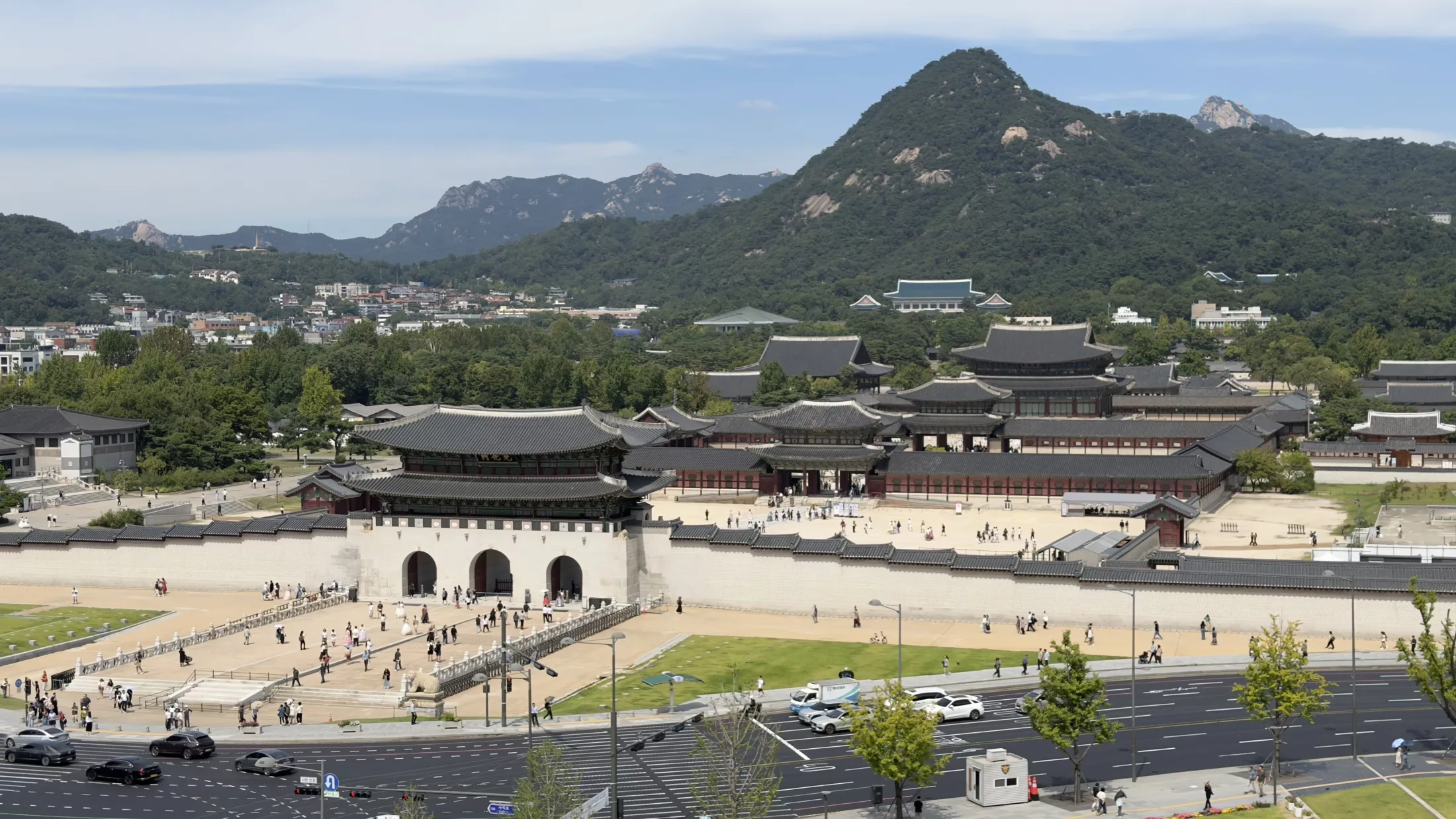
Statistically speaking, this obviously isn’t very meaningful. Psychologically, however, it’s more than enough to throw our “stranger radar” off. And that’s precisely what makes the next day quite amusing. The following day, we visit Gyeongbokgung, the former main palace of the Joseon Dynasty. Before we’d even made it very far into the complex, a man spontaneously came up to talk to us. He asks us where we’re from, how long we’re staying in Seoul, and chats casually with us.
Nothing strange, nothing pushy. Yet, after the encounters from the day before, our minds remain on guard. We almost expect the moment when he’ll invite us to some mysterious traditional ceremony.He didn’t do anything of the sort. He simply wanted to chat.
This brief conversation made us realize that in less than twenty-four hours, a few unusual experiences had been enough to change our perception of the encounters that followed. With that thought in mind, we set out to explore the palace. Originally built in 1395, destroyed, rebuilt, and then restored several times, Gyeongbokgung is today one of Seoul’s most iconic landmarks. But what strikes us most are the visitors.
Since admission is free for those wearing a hanbok, hundreds of Koreans and foreigners wander through the courtyards and pavilions in traditional attire. Amid the curved roofs, painted doors, and all these figures in traditional dress, the palace almost seems inhabited. We then continue on to Bukchon Hanok Village. Hanoks are traditional Korean houses, recognizable by their curved roofs and wooden architecture. Bukchon isn’t a reconstructed set but a real residential neighborhood where these houses are still part of everyday life.
Yet, upon arriving, it almost feels like stepping into a movie set.
The narrow streets are beautiful, the facades perfectly photogenic, and there are plenty of visitors.
Then we notice the signs asking us to keep quiet. “Shhh.” Of course, that cracks us up. From then on, all it takes is for one of us to speak a little too loudly for the other to immediately shush them.
Then the opposite happens. And it quickly becomes our running joke throughout the entire walk. Behind the humor, the signs serve a real purpose.
Residents live behind these doors, and Bukchon’s popularity with tourists has become so overwhelming that visits are now restricted on certain streets. In the evening, we head back to the DDP. This time, the massive silver building itself becomes a screen. Light projections glide across its curved facades, hugging the architecture, making it disappear and then reappear. Earlier, we were looking at drawings inside.
Now, the entire building itself becomes a work of art. We stand there for a long time, and, without really realizing it, we’re starting to really like Seoul. That doesn’t mean everything is perfect, though. We cross Gangnam to check out the famous Starfield Library at COEX Mall, which we’ve seen in photos hundreds of times. Its thirteen-meter-tall bookshelves are pretty, of course.
But for us, it’s probably one of the biggest disappointments of the trip. Lots of Instagram-worthy shots but, in the end, not much to get excited about. We still took a photo in front of the giant Gangnam Style hands. There are some things you just can’t resist.
Then we headed to Seongsu and Seoul Forest, and the city’s personality changed yet again. Trendy shops, our one and only stop at a Korean photo booth, then suddenly a huge park, deer, insects, butterflies, and the Han River at the end of the path. A few stops later, the scenery changes again: Hongdae, with its street musicians, arcades, and claw machines. That’s where Matthieu wins our new treasure: a tiny plush hamburger. Ever since we arrived in Korea, we’ve noticed these little trinkets hanging everywhere.
On backpacks, fanny packs, handbags, or even phones. Here, the accessories sometimes seem to have their own accessories.
So when Matthieu wins his first hamburger from a claw machine, he tries his luck a second time. Against all odds, he wins a second one in a row. A few minutes later, we each had exactly the same hamburger attached to our bags. Our new Korean fashion accessory—and we’re absurdly proud of it. In Myeongdong, the crowd thickens and food takes over the streets. We wander from one stall to the next, tasting, sharing, and discovering, in particular, an egg-based specialty that’s much sweeter and saltier than the pastries its appearance made us think of. The day then comes to a close along Cheonggyecheon, the landscaped stream that runs through the center of Seoul.
In the evening, the banks fill with locals who come to sit by the water, chat, eat, or simply enjoy the cool air.
Under the city lights, the place has a particularly lively atmosphere. But our most beautiful view of Seoul is actually much higher up. From Sangye Station, we decide to hike up Buramsan. The apps predict a much longer hike, but in less than three-quarters of an hour we reach the rocks near the summit, at an elevation of 508 meters.
The trail is remarkably well-maintained and marked, with a few steeper sections on the granite. What strikes us immediately is the calm. Even though the city has nearly ten million residents, we encounter relatively few people. From the street, we’d been struck by the repetition of its architecture—those immense complexes of buildings that sometimes seem to be identical copies of one another from one neighborhood to the next. From Buramsan, this uniformity takes on a strangely beautiful quality. The blocks transform into patterns, the mountains cut across the horizon, and the evening light gradually colors the entire city.
We stay up there for nearly an hour and a half. The sun is setting, it’s starting to get cool, and, little by little, thousands of windows and streets light up beneath our feet. We take way too many photos, then eventually put our phones away.
To see Seoul from above, many people choose Namsan and its famous tower. As for us, we’d choose Buramsan without hesitation. Admission is free; the climb took us about 40 to 45 minutes, and that evening, looking out over this immense metropolis, we almost felt as if we were alone.
It was probably our most beautiful moment in Seoul.
Yet the city still had one last surprise in store for us—an artistic one this time.
At the MMCA Seoul, we visited the major exhibition dedicated to Do Ho Suh, one of South Korea’s most renowned contemporary artists. Some of his works are life-size reproductions of domestic spaces made of translucent polyester fabric. Doors, hallways, light switches, and architectural details appear before us like the ghosts of houses we could take with us. Then we have to get closer.
In *Who Am We?*, what looks from a distance like a simple colored surface reveals a multitude of tiny faces.
In *Floor*, a transparent floor that appears to be dotted with small points is actually supported by a crowd of tiny figures. Individually almost invisible, together they literally bear the weight of those walking above them. It’s spectacular without needing to be monumental. And perhaps that’s when we finally understand what we love so much about this city: in Seoul, you often have to get up close before you understand what you’re looking at.
Even HAUS NOWHERE plays this little trick on us. Even before entering, it’s the architecture that catches our eye.
Located in the Seongsu neighborhood, the building looks more like a contemporary sculpture. Raw concrete dominates everywhere. The volumes are massive, the lines geometric, and the openings immense. Some parts seem to have been carved directly out of the material. Seen from the outside, you almost expect to discover a museum or a contemporary art center. The reality is a little different.
HAUS NOWHERE is a vast experimental space where art installations, scenography, and shops blend together, sometimes giving the impression that you’re visiting a gallery. One section of the building is occupied by Gentle Monster, the famous South Korean eyewear brand known for transforming its stores into truly immersive experiences. It’s precisely there that we stumble upon an activity absurd enough to convince us to wait. An AI program transforms our faces into vegetable characters printed on trading cards—somewhere between a personalized portrait and a vegetable garden version of Pokémon.
So we get in line to get our very own vegetable heads. Between major sightseeing stops, Seoul also offers us a few lighter experiences. A caricature of the two of us drawn in five minutes at Acorn Caricature for about 14,000 won. A gym that offers us a 50% discount in exchange for a five-star review, before providing us with towels, T-shirts, and shorts so we can work out fully dressed in the gym’s colors.
And then there’s Itaewon. We’d already been there on the first Sunday evening. A good, down-to-earth eatery, a few drinks at an almost empty LGBTQ+ bar, then an attempt to wrap up the night at a club. We were turned away.
Not because we’re two men. Because we were wearing Birkenstocks.
We may not always have the style, but at least we have the comfort.
A few days later, we decided to give the neighborhood a second chance.
This time, we started off very simply with some cans of beer bought at a CVS and drunk outside, in front of the store.
It had probably been years since we’d spent an evening like that, and for that very reason, it made us laugh a lot.
We then headed to a bar for soju cocktails—sort of like gin and tonics where the gin is replaced by Korean liquor. Six days earlier, we were seriously wondering what we’d just gotten ourselves into. Now we know the answer. In a city that took us a few days to figure out its ways and adjust our own frame of reference. A city that surprised us, sometimes left us bewildered, and very often impressed us.
Seoul is immense yet calm, extremely organized without being boring, capable of shifting from a 14th-century palace to a futuristic facade bathed in light, from an almost empty mountain to a street packed with thousands of people, from a monumental brutalist building to two rounds of cards that left our heads feeling like vegetables.
At first, we inevitably viewed all of this through the lens of what we already knew.
The strange encounters during our first few hours in the city had heightened this tendency.
Then, day after day, we stopped trying to compare everything.
And what had seemed so different when we arrived became a big part of what we came to love.
Seoul—but what on earth had we just landed in?
In a city that first threw us off balance before winning us over.
A city where you sometimes have to get up close before you can understand what you’re looking at—whether it’s a work by Do Ho Suh, a neighborhood, a local custom, or simply a conversation with a stranger.
In the end, perhaps it wasn’t Seoul that was strange.
It was mainly our perspective that needed a little time to adjust.