“I feel like I’m in *The Teletubbies*.”
That’s really the first thing you think when you see the huge, perfectly green hills that dot the parks of Gyeongju. Except that here, beneath those mounds, there are tombs. And sometimes they belong to kings and queens who lived over a thousand years ago.
For nearly a millennium, from 57 BCE to 935, Gyeongju was the capital of the Silla Kingdom. Members of the royal family and the aristocracy were buried in large tombs covered first with stones and then with earth. Some of these tombs have yielded jewelry, precious objects, and the famous gold crowns that have since become one of the symbols of Silla.
We arrived by train from Seoul, then took a bus to the historic center. A handy bit of good news: our T-money card—the rechargeable card we’d already been using on Seoul’s buses and subways—works here too. We discover that we can actually keep using it throughout Korea, which really makes our lives easier.
At the hotel, another pleasant surprise: after our 11 m² room in Seoul, we finally have a room where we can spread out our things without blocking the way. We set down our bags and head out almost immediately, because it’s already dark and, more importantly, we’re very hungry.
On our way to dinner, we pass through our first park filled with tumuli—those large, green hills beneath which lie the tombs of the ancient kings and queens of Silla. And that’s probably what surprises us most about Gyeongju: the tombs never really seem separate from the city. We go from a street to a park, from a restaurant to a royal tomb, and it all feels completely natural.
That evening, Matthieu found a dakgalbi restaurant filled almost entirely with locals. A pretty good sign. Right in front of us, chicken, vegetables, and udon are cooking in a gochujang-based sauce directly on a large hot plate. It’s slightly spicy, hearty, and absolutely delicious.
On our way out, we noticed lights in another park. We walked over without really knowing what was going on and stumbled—completely by chance—upon one of the best surprises of our trip.
For a few weeks in September, the Daereungwon Media Art Festival transforms the royal tombs into massive projection surfaces. Golden crowns appear on the hills, figures take shape in the grass, and light installations weave through the trees. Part of the show tells the story of Silla and the importance of gold in that civilization.
Just a few hours earlier, these hills reminded us of the Teletubbies. Now, we’re watching over a thousand years of history projected right onto them.
Above all, we’re incredibly lucky to be here at just the right time.
We wrap up our first evening in the Hwangnidan-gil area, with its hanok-style houses converted into cafés, restaurants, and small shops. We took a few photos in a photo booth, grabbed a sweet treat—an ice cream—and then headed back to our place.
The next day, we decided to see as much as we possibly could in a single day.
We start with Bulguksa, less than forty minutes away by bus. The Buddhist temple is much larger than we’d imagined, with several pavilions, pagodas, stone staircases, and all the colors of traditional Korean architecture. It was crowded, but there was still enough space to stroll around peacefully and take the time to admire the details. We really liked it.
Since Seokguram is right next door, we naturally thought it would be a shame not to visit both. In hindsight, we could have easily skipped it.
Seokguram is historically significant: this 8th-century man-made cave houses a large stone Buddha and, along with Bulguksa, is listed as a UNESCO World Heritage Site. But as a visitor experience, we were frankly left wanting more. You have to take another bus, walk a little further, and then you see the Buddha behind a glass pane, with no possibility of taking photos. A few minutes later, we were already on our way out.
If we had to do it all over again with only one or two days in Gyeongju, the choice would be pretty simple: Bulguksa, yes; Seokguram, we’d skip.
And it was precisely while trying to connect the two that we discovered another quirk of Korea: Google Maps is terrible here. Some addresses are approximate or simply don’t appear, and some paths don’t even seem to exist on the map.
Fortunately, one of us had downloaded KakaoMap, the local navigation app. Looking at it, we discovered that there is indeed a path connecting the two sites on foot through the forest. Since then, KakaoMap has become our go-to whenever we need to get around.
Back in the city center, we had lunch at a small restaurant surrounded by hanok-style houses. It was the weekend, so there was a street market and crowds of people, but the atmosphere remained surprisingly pleasant.
We continue on to Donggung Palace and Wolji Pond, the former site of the Silla royal palace. A few pavilions now line the pond, their reflections shimmering on the water, and we simply keep walking among the parks, tombs, and various historic sites.
And that’s probably what we love most about Gyeongju. Everything is all mixed together.
We step out of a café, walk through a park filled with royal tombs, reach an ancient palace, and, a few minutes later, find ourselves back in front of shops or photo booths. The city is flat, easy to explore on foot, and small enough that you can visit one place after another without constantly feeling like you’re rushing from one tourist site to the next.
After Seoul, this break really does us good.
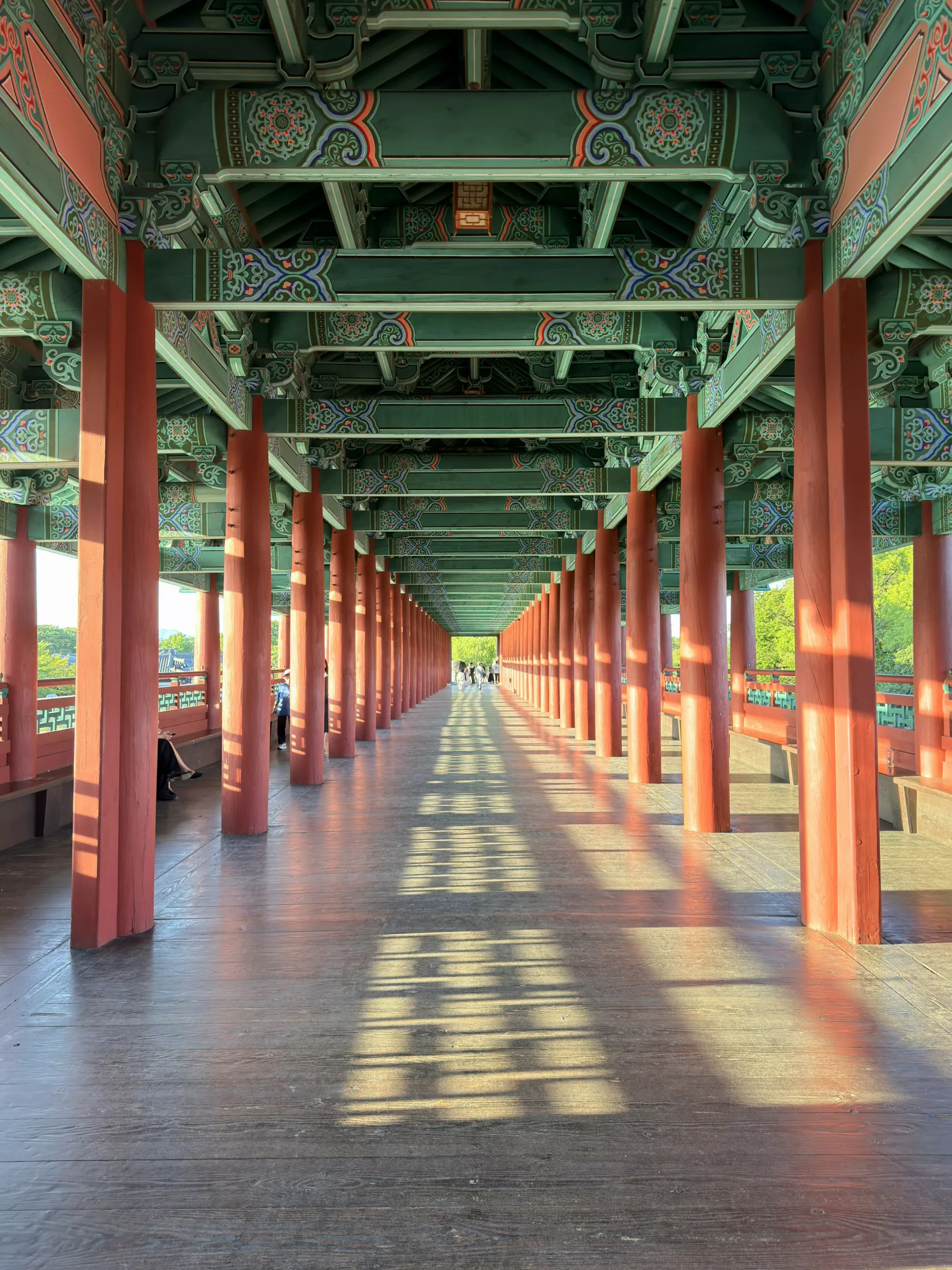
We eventually reach Woljeonggyo Bridge, one of Gyeongju’s most famous landmarks. The large red-and-green covered bridge is truly impressive.
But there’s one detail we didn’t know before coming: what we’re looking at today is a modern reconstruction of a bridge that already existed during the Silla period. The current structure was rebuilt in the 21st century.
And that’s always a bit strange for us. We can find the result magnificent while inevitably feeling less emotion when we know that the structure we’re looking at isn’t actually the one that stood there over a thousand years ago.
Of course, that doesn’t stop us from going to eat and then coming back to see it at night. Illuminated and reflected in the water, it’s even more beautiful.
At the end of the day, our phone shows about 33,000 steps.
We could reasonably head home to sleep. Instead, we head back to Hwangnidan-gil to try to win some plush toys.
And it’s while spending another evening there that we notice something we really love about Korea. There are claw machines everywhere, photo booths, cafés, tea rooms, ice cream shops, dessert spots, boutiques, and even fortune-tellers. But, as it turns out, there aren’t that many bars.
Couples and groups of friends simply spend their evenings playing games, taking photos, having a drink, or trying to walk away with a stuffed animal. It’s very different from many Western cities we know, where a lively street at night often revolves much more around bars and alcohol. Here, it’s lively, but also very laid-back.
And that’s probably where Gyeongju’s “cute” side strikes us the most. Between the little houses, the cafés, the photo booths, the stuffed animals, and all those big green hills rising up in the middle of the city, everything seems almost too cute for an ancient capital filled with royal tombs.
The next morning, before heading out, we went back to see the burial mounds one last time. We wanted some daytime photos, when their shapes really stand out and—sorry, Silla kings—the feeling of being in a Teletubbies episode gets even stronger.
But after a day and a half in Gyeongju, we’re already looking at them differently.
At first, we mostly saw just some funny green hills. Then we saw golden crowns and the entire history of Silla projected onto them. And finally, we got used to simply walking right through the middle of them, just like everyone else does.
That’s probably what made the biggest impression on us here: the boundary between the city and its dead seems to almost disappear. The tombs aren’t hidden on the outskirts, far from residential areas. They’re right there, amid the walking paths, cafés, and everyday life.
So how can a city surrounded by tombs be so charming? Perhaps precisely because, in Gyeongju, the dead have never frozen the city in time. People have simply lived alongside them for centuries.
This little green oasis—easy to explore and completely different from what we’d imagined—did us a world of good.