“Hello!”
We turn around. A child is looking at us from his tiny motorcycle.
“Xin chào!”
His face lights up, and he speeds up to catch up with us. Two others follow him, then another. We’re on motorcycles too, with one small difference: they’re designed for children.
We turn onto the vast Nguyễn Tất Thành Square, facing the sea. Towering above us is a monument over fifteen meters tall depicting Nguyễn Tất Thành—the future Ho Chi Minh—alongside his father, Nguyễn Sinh Sắc. The Vietnamese flags add a touch of solemnity to the scene. And right in front of us, dozens of children are riding around on mini-motorcycles and small electric cars. We’re among them. The contrast is pretty amazing.
For 40,000 dongs (about 1.30 CHF), we find ourselves behind the handlebars of two vehicles that are way too small for us, chased by a little group shouting “Hello!” at us. We reply, “Xin chào!” and, every time, it seems to make them even happier. We aren’t the only adults taking part, but we’re clearly not the majority. We’d originally just gone out to get some ice cream. We may have just found our favorite thing to do in Quy Nhơn.
And thinking back on it, all these little interactions hadn’t really started in that square. A few hours earlier, in a perfectly ordinary supermarket, we’d already been met with the same curious glances and the same smiles.
We’d barely arrived at the hotel. We put our bags down in a very comfortable room, discovered the rooftop pool, and, looking out the window, spotted a GO! about a ten-minute walk away. After more than a month in Vietnam, we’re a little embarrassed to admit it, but seeing a big supermarket again excites us almost as much as a tourist attraction. We want some fruit and a few drinks, so we head back out almost immediately.
Inside, we quickly notice that something is different. People are staring at us a lot. Some turn around in the aisles; others seem to follow us for a few meters. Then someone approaches Matthieu and, in rather hesitant English, says to him with a huge smile:
“You are handsome. You are so handsome. You are so handsome.”
A child simply comes over to shake Sébastien’s hand. Others watch us with wide eyes. We’re not quite sure anymore whether we came to buy fruit or if we’ve just walked onto a Vietnamese reality TV show that nobody warned us about.
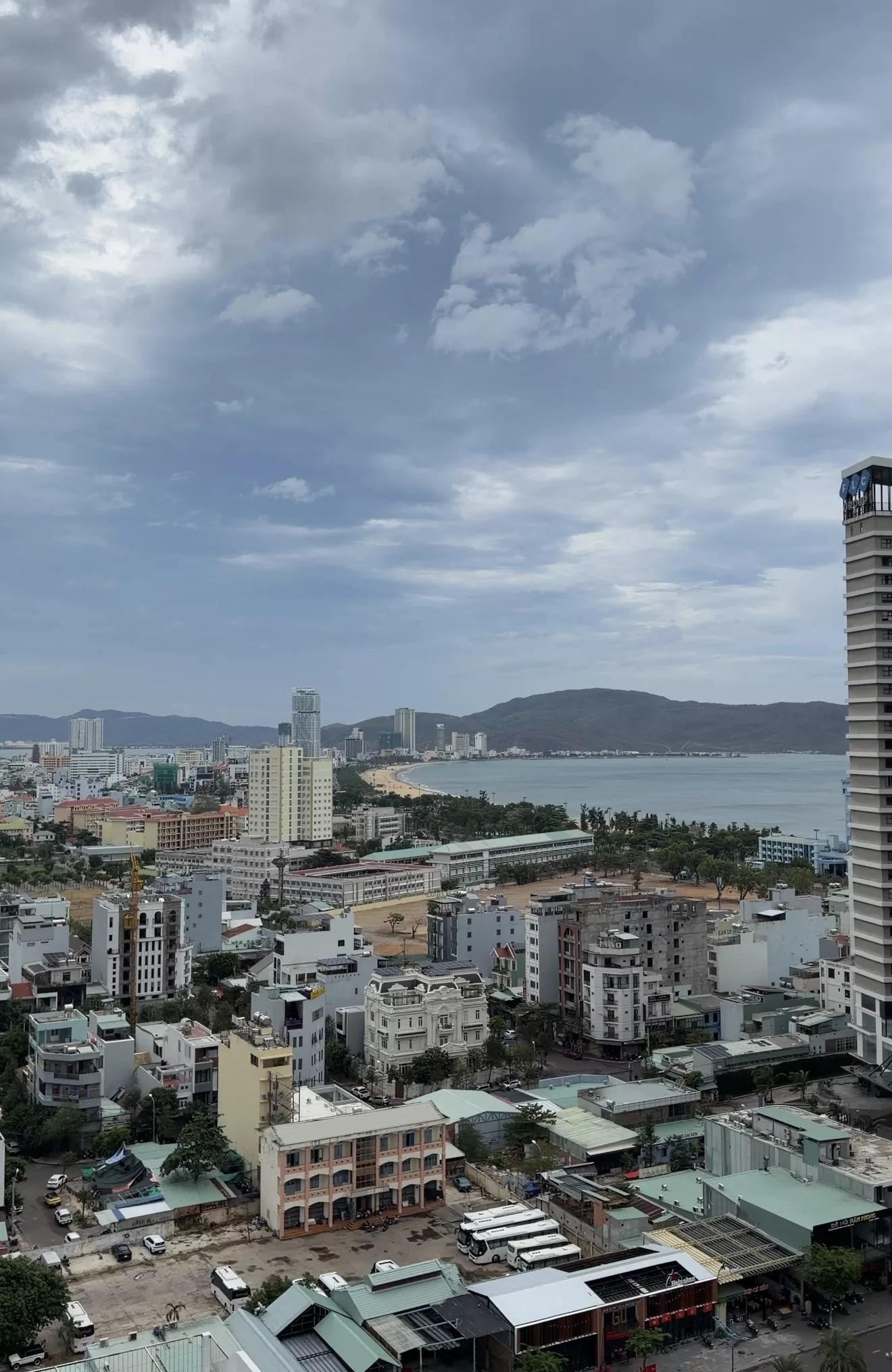
Quy Nhơn is, however, a true beach destination, with a long beach right in the city and kilometers of coastline all around. But unlike many of the stops on our trip, it mainly attracts Vietnamese visitors and far fewer international tourists. Suddenly, the stares in the supermarket start to make a little more sense.
That same evening, we set out to explore the neighborhood. It’s Saturday; the streets are bustling despite the gray sky, and our hotel is barely a ten-minute walk from downtown. We stroll along the sea with no real plan, and it’s while heading out to get that famous ice cream that we stumble upon the large square and its mini-motorcycles. We have so much fun that we already know we’ll do it again if the chance arises.
That’s probably a good thing, because the main reason we came to Quy Nhơn would completely slip through our fingers: the beach.
For four days, the sky remained hopelessly gray. It rained regularly, it was windy, and our attempt to explore the beaches around town by scooter came to a quick end. No sooner do we reach the coast than the rain starts. We push on anyway to a small fishing village, but the weather keeps getting worse. This time, there’s no point in pushing it: we head back.
Since we couldn’t experience Quy Nhơn as the beach resort we’d imagined, we simply started enjoying the city. Our hotel was fantastic, with a rooftop pool where we swam even under the clouds and a gargantuan breakfast. We find a gym, play pickleball, eat well, and walk a lot. And in the end, it’s all these ordinary outings that turn out to be the most interesting.
At restaurants, a little ritual even ends up taking hold. As soon as we sit down, we almost automatically pull out our phones. Across from us, the server immediately understands what’s in store and pulls out their own. Sometimes we see them chuckle when they see us coming. Other times, someone goes to find the person at the restaurant who speaks the best English. A few seconds later, everyone gathers around a screen to communicate through translation apps, with lots of gestures and a few attempts at pronunciation. It’s sometimes a struggle, often very funny, and always done with disarming kindness.
The same thing happens on the street. People call out “Hello!” to us from their scooters, children follow us with their eyes, and some come up to us spontaneously. Others simply stare at us so intently that it mostly ends up making us laugh. And when we reply, “Xin chào,” their faces almost always light up.
Little by little, we realize something quite amusing: we’d come to Quy Nhơn as tourists, but here, we sometimes get the impression that it’s the locals who are coming to see us.
On our last night, we head back to the main square. Some evenings, people rent rollerblades there. That night, the little motorcycles are there again, and it doesn’t take us long to grab two. A few minutes later, there we were once again surrounded by children—far too big for our scooters—exchanging “Hello!” and “Xin chào!” with the Vietnamese flags and the massive monument to Nguyễn Tất Thành and his father behind us.
So we left Quy Nhơn after four nights with a rather unexpected outcome: almost no sun, a failed attempt to explore its beaches, and ultimately very few things we could check off a “to-do” list.
And yet, we loved this city.
Because in Quy Nhơn, our best memories didn’t come from what we’d set out to see, but from all the little encounters that happened simply because we were there.
We’ll be back for the beaches, hoping this time the weather will be nice. But also because we’d really like to know if, next time, we’ll still be the tourist attraction.